Option 1: 3 Wards
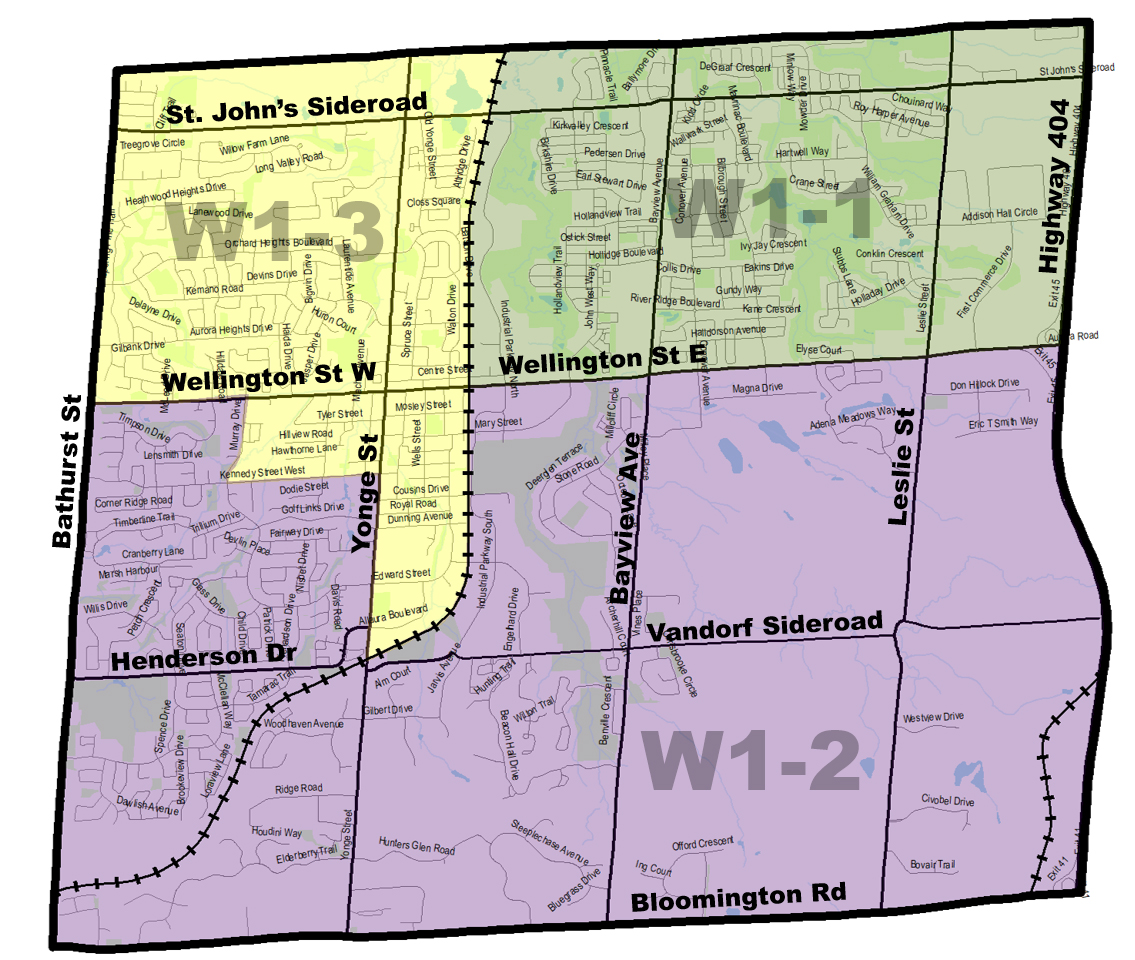
| Town of Aurora - Ward Boundary Options Forecast Census Population at Election Year |
Population 2022 | Variance from average | Population 2026 | Variance from average | Population 2030 | Variance from average | Population 2034 | Variance from average |
|---|---|---|---|---|---|---|---|---|
| W1-1 | 23,540 | 11.0% | 25,520 | 12.6% | 27,100 | 13.9% | 28,240 | 14.6% |
| W1-2 | 20,430 | -3.6% | 21,680 | -4.3% | 22,680 | -4.7% | 23,380 | -5.1% |
| W1-3 | 19,640 | -7.4% | 20,780 | -8.3% | 21,630 | -9.1% | 22,290 | -9.5% |
| Average Ward Population | 21,200 | 22,660 | 23,800 | 24,640 |
Option 1 contains 3 wards. The average 2026 ward population is 22,660. Ward populations in this Option range from 20,780 to 25,520 with a variance from the average of -8% to +12.6%., well within the appropriate range for voter parity.
Option 1 also keeps communities together (a map of Aurora Neighbourhood Associations can be found in Appendix A to the Options Report). In addition to major roads like Yonge, Wellington and Bayview, and the railway tracks, this Options also uses neighbourhood streets like Kennedy Street West and Murray Drive as ward boundaries.
Implications for Council composition
In the 3 Ward Option there would have to be more than one councillor per ward to meet the Municipal Act requirement of a minimum council size of five members, including the Mayor. Electing two Councillors per ward would be the most direct way of implementing Option 1. The result would be a Council of seven members. A Deputy Mayor would have to be elected by Council or appointed by the Mayor.
Another approach would be to reduce Council size to five members. In this configuration, there would be one Councillor per ward plus a Mayor and Deputy Mayor elected at-large.
Option 2: 4 Wards
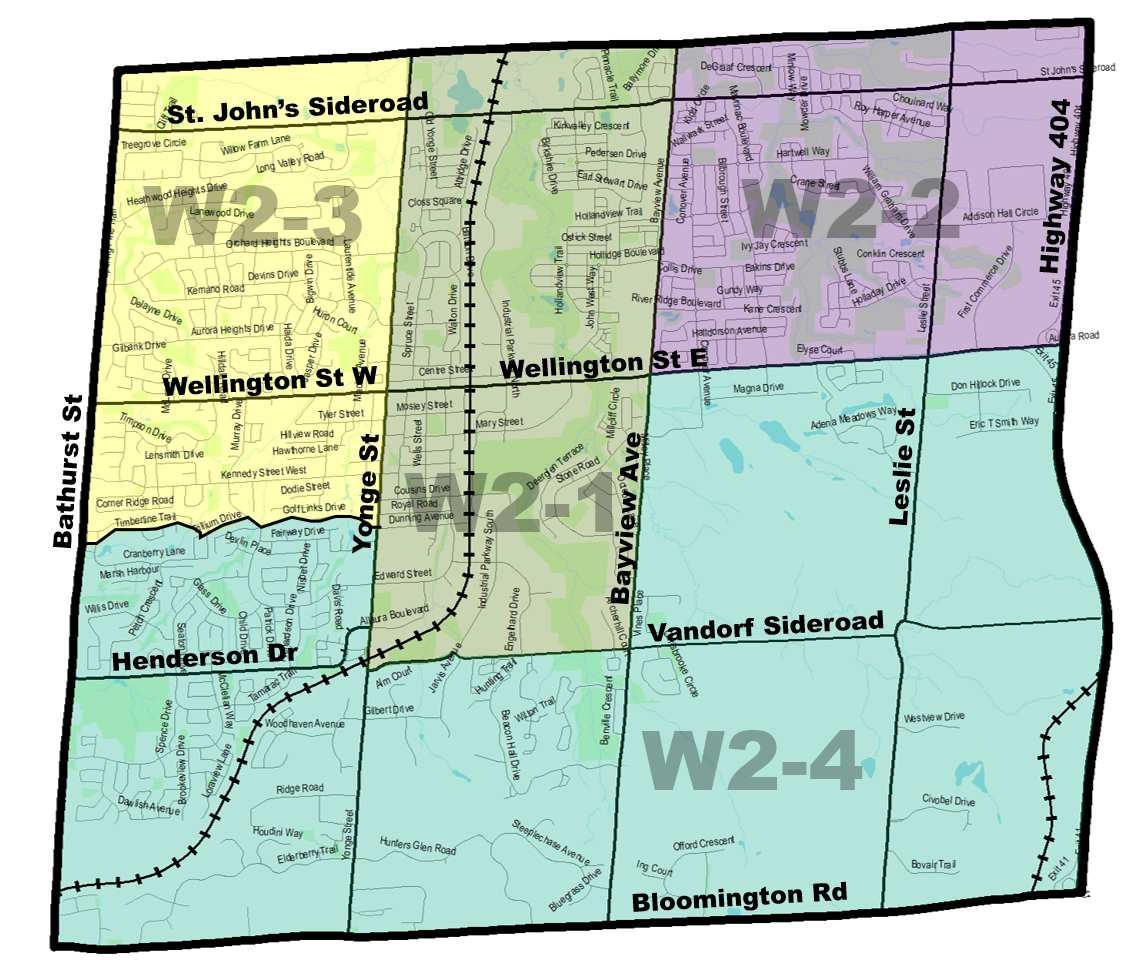
| Town of Aurora - Ward Boundary Options Forecast Census Population at Election Years |
||||||||
| OPTION 2 | Population 2022 | Variance from average | Population 2026 | Variance from average | Population 2030 | Variance from average | Population 2034 | Variance from average |
| W2-1 | 15,960 | 0.4% | 16,510 | -2.9% | 16,940 | -5.1% | 17,250 | -6.7% |
| W2-2 | 15,990 | 0.6% | 17,840 | 4.9% | 19,310 | 8.2% | 20,380 | 10.3% |
| W2-3 | 14,640 | -7.9% | 15,500 | -8.8% | 16,140 | -9.6% | 16,640 | -10.0% |
| W2-4 | 17,020 | 7.0% | 18,130 | 6.6% | 19,020 | 6.6% | 19,640 | 6.3% |
| Average Ward Population | 15,900 | 17,000 | 17,850 | 18,480 |
Option 2 contains 4 wards. The average 2026 ward population is 17,000. Ward populations in this Option range from 15,500 to 18,130 with a variance from the average of -8.8% to + 6.6%. This voter parity range is excellent.
Option 2 also uses major roads like Yonge, Wellington, Bayview and Vandorf Sideroad as ward boundaries. Most communities are kept together (see Appendix A of the Options Report). However, to achieve voter parity, the northern part of the Highland Gate community had to be split off by drawing the southern boundary of W2-3 along Timberline Trail/Trillium Drive and Golf Links Drive. Also, the railway tracks are not a ward boundary in Option 2 but are contained in W2-1 and W2-4 respectively.
Implications for Council composition
This Option would lead to a Council of five members, four Ward Councillors plus the Mayor. A Deputy Mayor would have to be elected by Council or appointed by the Mayor. If a slightly larger Council was desirable, a Deputy Mayor could be elected at-large for a Council of six members.
Option 3: 5 Wards
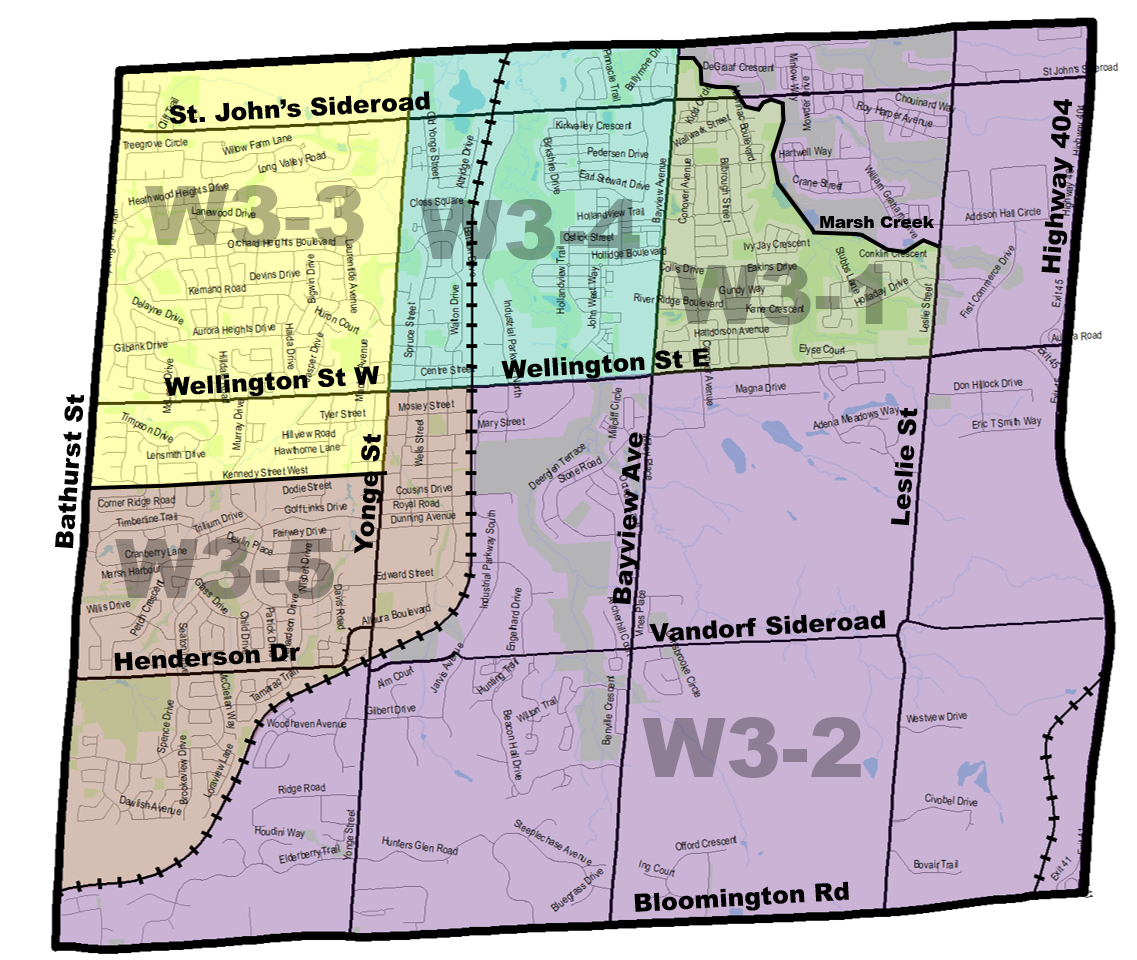
| Town of Aurora - Ward Boundary Options Forecast Census Population at Election Years |
||||||||
| OPTION 3 | Population 2022 | Variance from average | Population 2026 | Variance from average | Population 2030 | Variance from average | Population 2034 | Variance from average |
| W3-1 | 11,390 | -10.5% | 12,720 | -6.5% | 13,770 | -3.6% | 14,540 | -1.6% |
| W3-2 | 13,360 | 5.0% | 14,800 | 8.8% | 15,940 | 11.6% | 16,730 | 13.2% |
| W3-3 | 14,040 | 10.4% | 14,880 | 9.4% | 15,520 | 8.7% | 16,010 | 8.3% |
| W3-4 | 11,610 | -8.7% | 12,030 | -11.5% | 12,350 | -13.5% | 12,590 | -14.8% |
| W3-5 | 13,210 | 3.9% | 13,550 | -0.4% | 13,830 | -3.2% | 14,040 | -5.0% |
| Average Ward Population | 12,720 | 13,600 | 14,280 | 14,780 |
Option 3 contains 5 wards. The average 2026 ward population is 13,600. Ward populations in this Option range from 12,030 to 14,880 with a variance from the average of -11.5% to +9.4%. The 5 Ward Option's voter parity range is entirely appropriate.
Option 3 keeps communities together (see Appendix A of the Options Report). This Option also uses major roads like Yonge, Wellington and Bayview as ward boundaries. Kennedy Street West, a neighbourhood street, is also a boundary. In order to balance ward populations, W3-1 had to be carved out of the north-east quadrant of Aurora. In addition to easily recognizable boundaries like Bayview, Wellington and Leslie, its north-eastern boundary is Marsh Creek. In this Option the railway tracks are a ward boundary south of Wellington.
Implications for Council composition
This Option would lead to a Council of 6 members, five Ward Councillors plus the Mayor. A Deputy Mayor would have to be elected by Council or appointed by the Mayor. If a Council size similar to the current Council was desirable, a Deputy Mayor could be elected at-large for a Council of seven members.
Option 4: 6 Wards
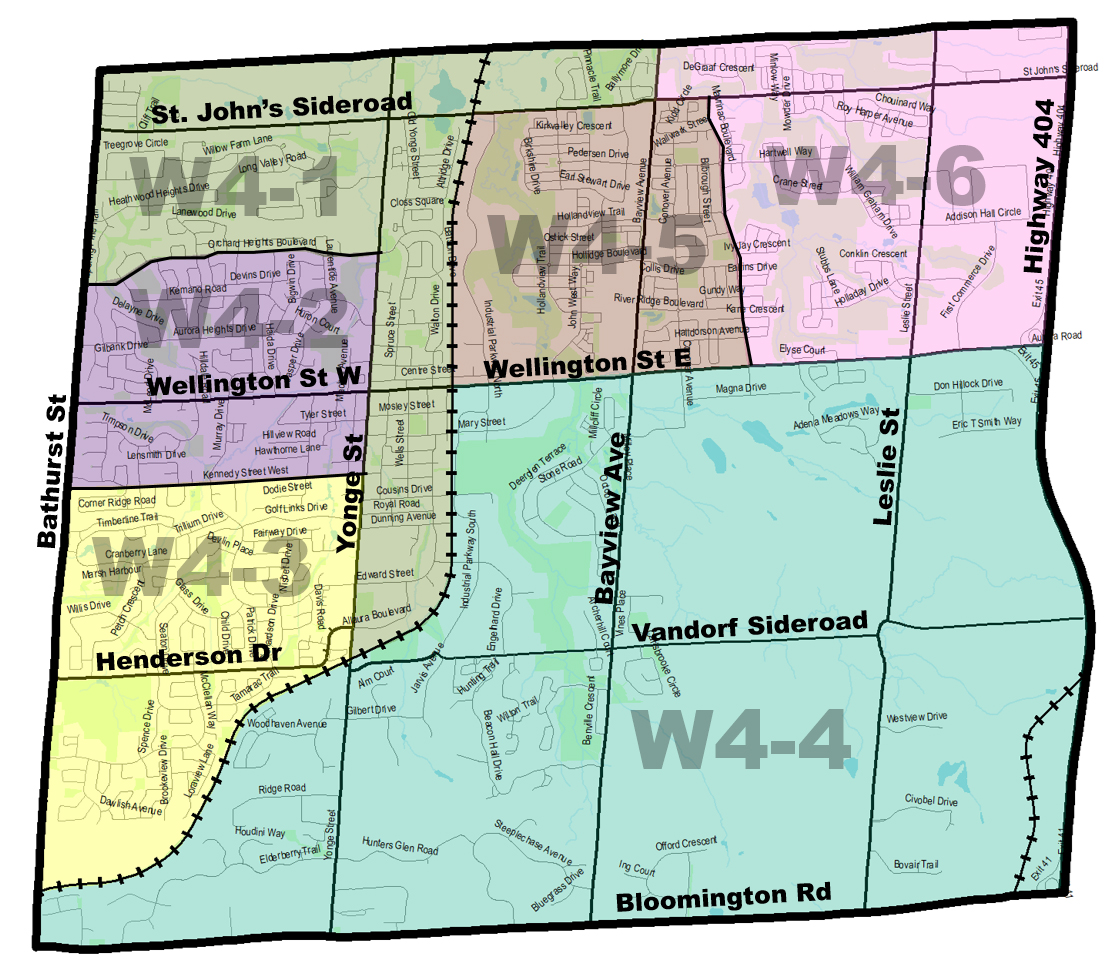
| Town of Aurora - Ward Boundary Options Forecast Census Population at Election Years |
||||||||
| OPTION 4 | Population 2022 | Variance | Population 2026 | Variance | Population 2030 | Variance | Population 2034 | Variance |
| W4-1 | 10,155 | -4.2% | 10,595 | -6.5% | 10,935 | -8.1% | 11,185 | -9.2% |
| W4-2 | 10,785 | 1.7% | 11,545 | 1.9% | 12,115 | 1.8% | 12,555 | 1.9% |
| W4-3 | 11,660 | 10.0% | 12,000 | 5.9% | 12,280 | 3.2% | 12,490 | 1.4% |
| W4-4 | 8,780 | -17.2% | 9,690 | -14.5% | 10,400 | -12.6% | 10,890 | -11.6% |
| W4-5 | 11,740 | 10.8% | 12,440 | 9.8% | 13,000 | 9.2% | 13,410 | 8.8% |
| W4-6 | 10,490 | -1.0% | 11,710 | 3.4% | 12,680 | 6.6% | 13,380 | 8.6% |
| Average Ward Population | 10,600 | 11,330 | 11,900 | 12,320 |
Option 4 contains 6 wards. The average 2026 ward population is 11,330. Ward populations in this Option range from 9,690 to 12,440 with a variance from the average of -14.5% to +9.8%.
The south-eastern ward (W4-4) is the smallest and, therefore, has the largest voter parity variance. This is due to the low-density development in this part of Aurora and the presence of the Oak Ridges Moraine (see Appendix B of the Options Report). However, this voter parity variance is still within acceptable levels.
Option 4 keeps most communities together (see Appendix A of the Options Report). However, by using Orchard Heights Boulevard as the boundary between W4-1 and W4-2, a small portion of the Aurora Heights neighbourhood is split from the main community to the south.
This Option also uses major roads like Yonge, Wellington and St. John's Sideroad as ward boundaries, as well as the majority of the railway tracks. Kennedy Street West, a neighbourhood street, is again a boundary and so is Mavrinac Boulevard in the northeast quadrant of Aurora.
All wards in Option 4 have clear boundaries. Only Ward W4-1 has an odd shape. The Consultant Team was faced with low population numbers in the north-west area of the Town. To achieve appropriate voter parity in this area with 6 wards requires adding population to the area bounded by Orchard Heights Boulevard, Yonge Street, Aurora's northern boundary and Bathurst Street. The logical area to be added is across Yonge to the railway tracks. However, those combined populations are still too low, or conversely the populations of the adjacent wards are still too high. To achieve appropriate voter parity, the area south of Wellington and the area north of St. John's Sideroad had to be added to Ward W4-1.
Implications for Council composition
This Option would lead to a Council of seven members, six ward Councillors plus the Mayor and would replicate the current size of Council. A Deputy Mayor would have to be elected by Council or appointed by the Mayor.


